



“Brand Beckham comes first.”
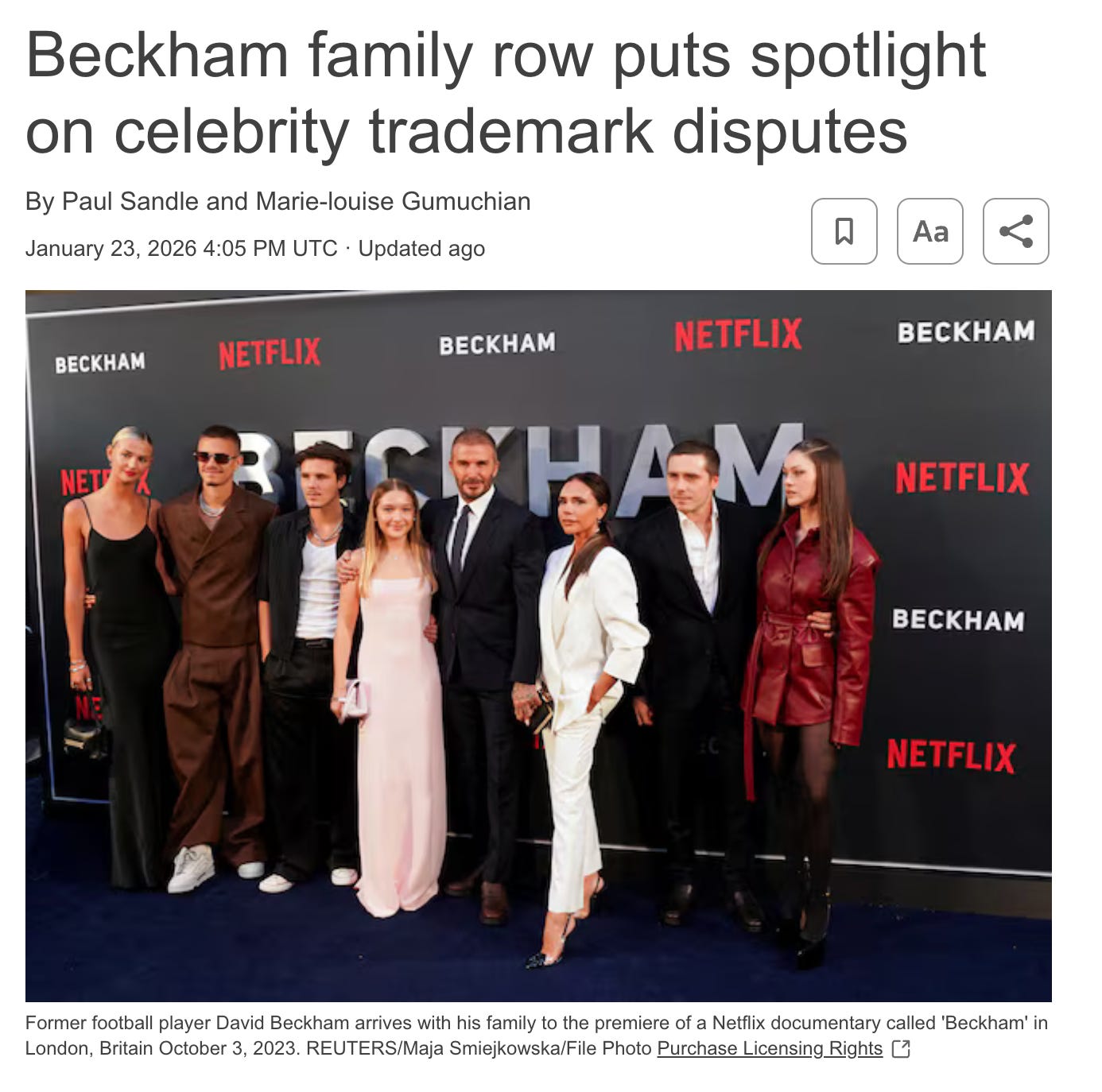
David Beckham’s son recently posted about being pressured to sign away rights to his own name.
He ignited an ancient debate with a modern twist. Names have always been more than syllables we answer to; they carry lineage, reputation, and social capital. A name marks kinship and legal identity: who you belong to, whose obligations and protections apply to you. Today, a name also functions as an asset class: a brand, a revenue stream, and sometimes a corporate legal entity. The Beckham dispute crystallizes this transformation. What was once an inherited label now sits within the architecture of intellectual-property law and global commerce.
Thinking of a name as private property forces us to confront a knot of ethical and practical questions. Property is ordinarily defined by excludability and transferability: I can buy a house; I can sell it; I can prevent you from entering it.
Reputational property: my name + my persona, is fuzzier. Its value arises relationally; it exists because other people recognize it and ascribe meaning. We can protect a name with trademarks in order to safeguard consumers from deception and enable ourselves to monetize reputation.
For celebrity families who have spent decades building a shared commercial identity, a family name can support whole companies and livelihoods. From a legal perspective, trademarking a name is a defensible, even rational, business choice. The ethical tension appears when protective measures collide with personal autonomy. If parents legally register their children’s names to manage future commercial exploitation, do they risk reducing an individual’s right to use their own identity freely?
Brooklyn Beckham claims he was pressured to sign away rights to his name ahead of his marriage. Dispossession: rather than parents giving their children security and freedom, business reasons can impede communal legacy.
What does it mean to treat reputation as a fungible commodity?
When a family manages and monetizes a surname, they are signaling that family identity is primarily an economic vehicle. It’s often a pragmatic decision but taken to an extreme it reframes intimacy as a series of corporate relationships.
Robert Frank and the market of reputations
Professor Frank’s writings examine status, positional competition, and how social preferences shape markets. He argues that economic behavior is primarily about relative status. As we compete to spend we signal our social ranking. A sale-able family brand institutionalizes this status and trademark law becomes a way to perpetuate “status rents”.
Families with high status will rationally attempt to protect their advantage. Ethically, we are left to determine whether the resulting social dynamics are desirable. If reputation-protection deepens inequality, then the social distributional effects matter.
The philosophical meaning of a name
A name anchors identity in others’ eyes. When a name is converted into property, two logics collide: the interpersonal logic of recognition and authenticity, and the market logic of exclusivity and profit. Who am I to myself and to those close to me? Who am I to consumers and counterparties? Can I authentically maintain a duality of myself?
Reputation is built over time through actions, achievements, and public perception. In the modern world it is especially fragile. It still depends on trust but increasingly on the story people tell about you.
A name sits at the intersection of personhood and property.
Is it realistic to think we can steward an intimate identity that is also a tradable asset …


