

You can look at the menu, but you just can’t eat
You can feel the cushions, but you can’t have a seat
You can dip your foot in the pool, but you can’t have a swim
You can feel the punishment, but you can’t commit the sin
We are not living through just another technological revolution. The Trump presidency is not a blip. Factually, briefly and non-partisan-ly; Trump’s sandwich was filled with an icon of old bureaucracy, desperately struggling to hold on to power. Energy, AI, and other technological inflections are topics du jour but they are components of a larger slow-moving arc: the incremental displacement of entrenched bureaucratic systems.
As the old bureaucracy is replaced with emergent formats we are going to see a simultaneous rotation of old money with new money. The new moneyed class (not limited to crypto bros) will accrue control over some emerging levers of value, while today’s old money slowly trundles off into the sunset and today’s new money becomes old money (over the next 50 years).
Bureaucracies are resilient and will always find ways to reinvent themselves. The old guard is out of sync with bureaucracy 2.0 because the core inputs of production (read: GDP): energy, information, money are all undergoing step changes in parallel. In short, new people will be able to exert new power on society.
Solar energy is a clarifying example. The conventional way of thinking about solar centers on terrestrial installations. I think of panels on roofs and farmers’ fields.
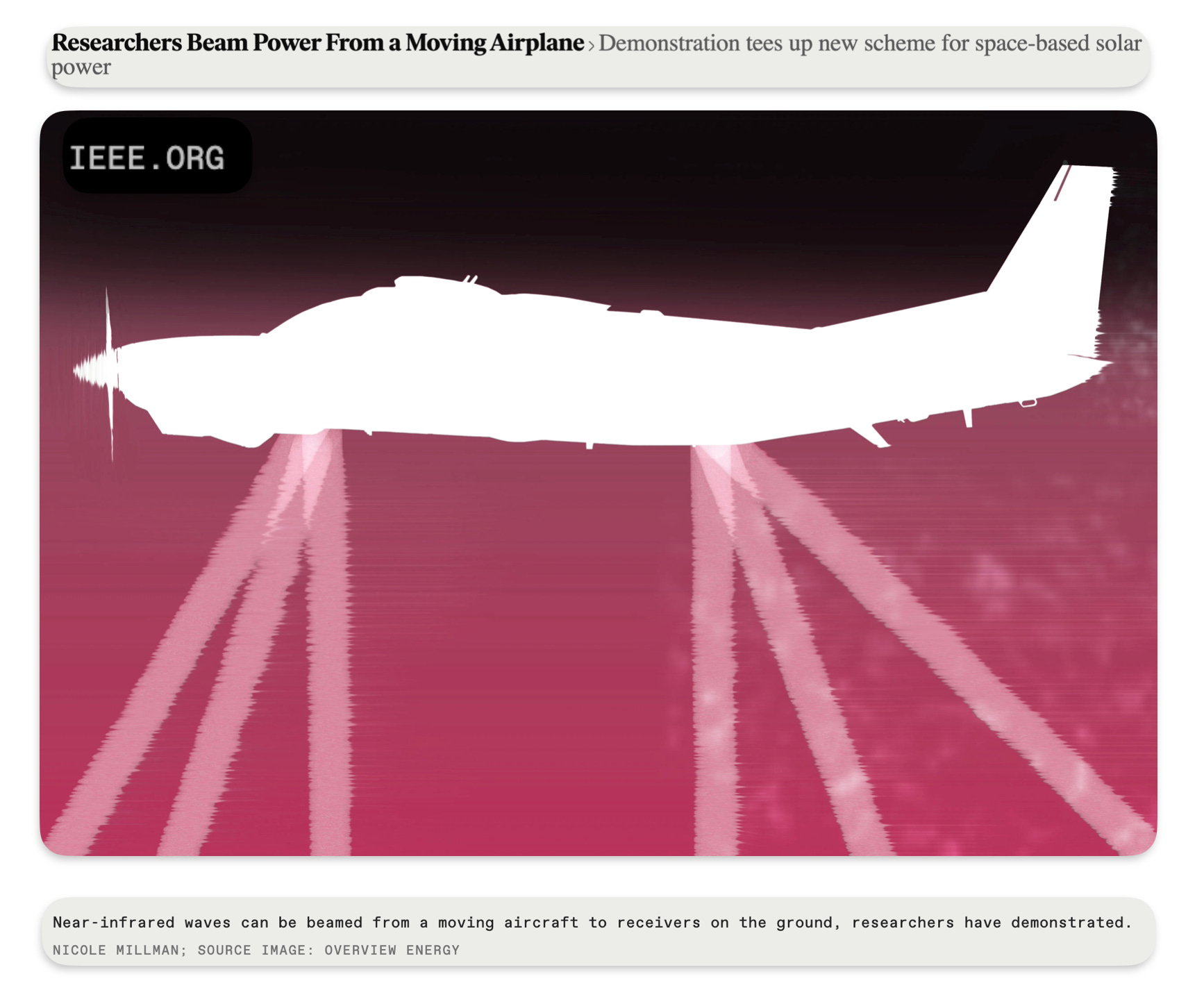
What got us here, won’t get us there. Capturing sunlight for energy will no longer be a terrestrial-first industry. Why harness the sun from farther away, when you can get closer to it and then beam it down to earth? And once humans can reliably collect and transmit concentrated solar energy from space then we alter the constraints that made centralized energy grids a good idea (they were invented to distribute energy from fossil fuels).
Electrical grids appear to be dated in most parts of the world - it’s almost as if we collectively have been planning for this moment in time; hoping that our decrepit infrastructure would last until we could reorient people to the power (e.g. small modular nuclear reactors and solar space energy).

John Cassidy wrote a punchy piece about AI abundance and how it might create value for new entrants in ways the oldies cannot easily imagine … or tax.
Total money = Old Money + New Money
New Money can’t immediately erase wealth accumulated under the old regime, nor does it want to. Instead, New Money competes for status, influence, and cultural authority. And they win, especially in the early innings (now).
The industrial age, personal computing and Internet-age produced similar rotations.
This time it’s different
You can build a mansion, but you just can’t live in it
You’re the fastest runner but you’re not allowed to win
Some break the rules, and let you count the cost
The insecurity is the thing that won’t get lost
A concrete corollary is the monetization of waste. Instead of flaring gas (waste) we print money by mining bitcoin wherever there is energy, transforming it into a store of value. The transition has implicated the state and its public bureaucracy because they did not see it coming. Bureaucracy’s role is to stabilize markets and arbitrate disputes.
Markets = humans transacting with each other
As energy distribution (read: SMRs), new communications networks (read: Starlink), and new modes of production (read: additive manufacturing) gain prominence the incentives and rules embedded in the old bureaucracy become frictions to progress.
New actors create parallel systems and new norms (read: it’s ok to say retard again).
How do we manage the human consequences of abundant automation and decentralized energy?
As AI continues to produce value that was previously generated by human labor, it makes sense for some humans to sit on the sidelines - if they can’t add value. Bureaucracy is supposed to serve humans to realize their highest potential. When it ceases to do so, the legitimacy of institutions are tested, as they are being today.
There is also an important geopolitical dimension. Multipolarity in energy and AI means that national advantage will increasingly be defined by creating resilient, decentralized services and capturing the downstream economic value. New wealth will seek to cement itself into institutions that confer legitimacy. Pay attention to the new names you see on stadiums and museums, but most critically pay attention to who gains control over the nodes that link energy, computation, and value.
Buckle up we are in the First Turning.
And you want her, and she wants you
We want everyone
And you want her and she wants you
No one, no one, no one ever is to blame


