

Put Your Money Where Your Mouth Is
On Prediction Markets
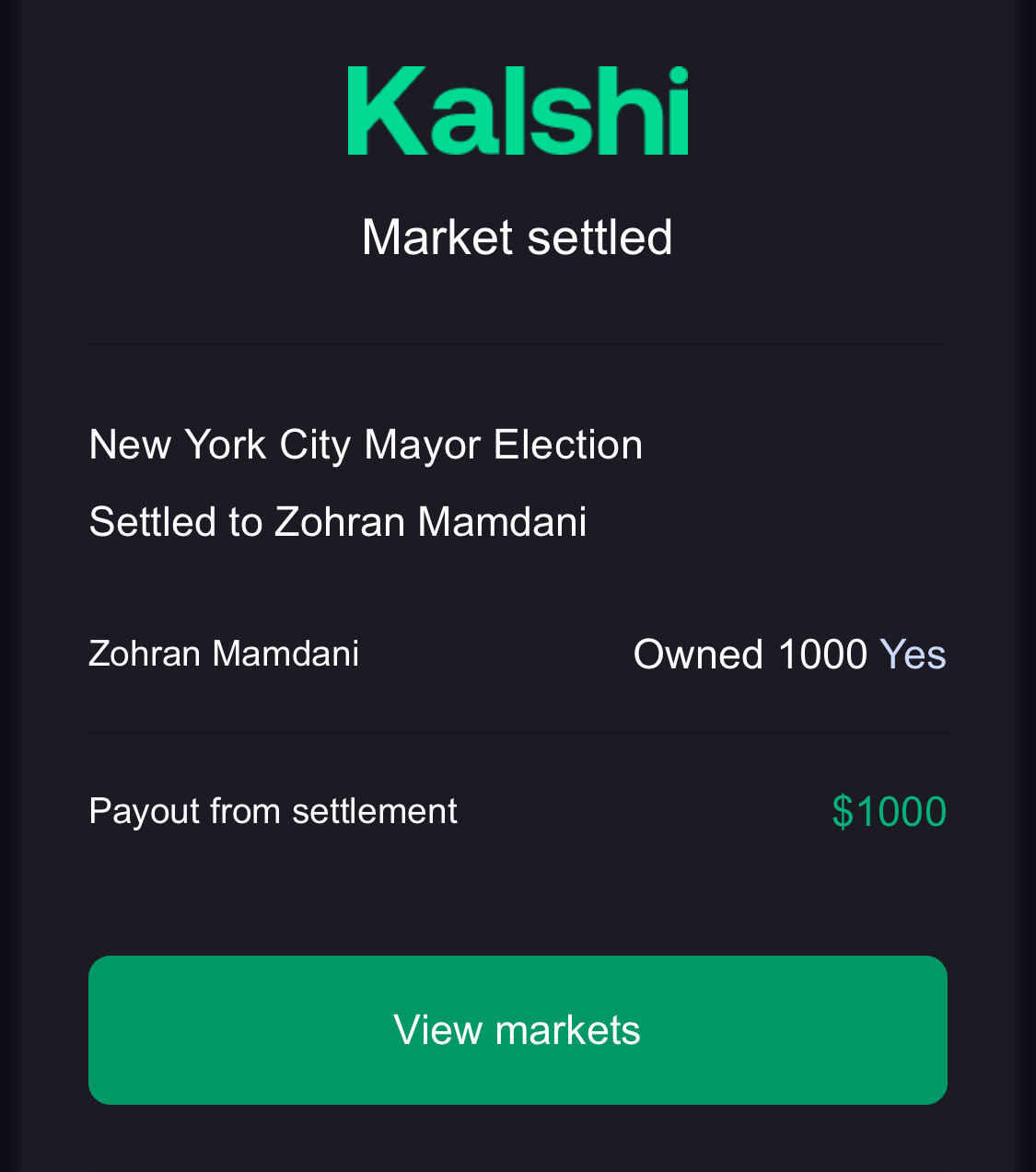
The new mayor of New York City, Zohran Mamdani, 34 years old, a super personable guy, has been everywhere. You can feel the rush to name, narrate, and predict; our cultural habit of turning people into signals. Everybody had a headline-ready verdict about him during his campaign and fo sho this will continue now that he has been elected.
Luckily we live in 2025 and now we can swap a pollster’s thermometer for Polymarket and Kalshi trades, and look at what’s actually being signaled, what’s noise, and what’s worth watching. I made a band on ZoZo - easy money.
Prediction markets vs. polling
Polling remains the public’s shorthand for “what will happen.” Polls are snapshots, useful but brittle: they reflect how a sampled group answers a bounded questionnaire at a particular time.

Polls are vulnerable to how questions are worded and prone to narrative shaping by media and elites. Prediction markets let people buy and sell contracts tied to outcomes. They are a different kind of animal: you put skin in the game.
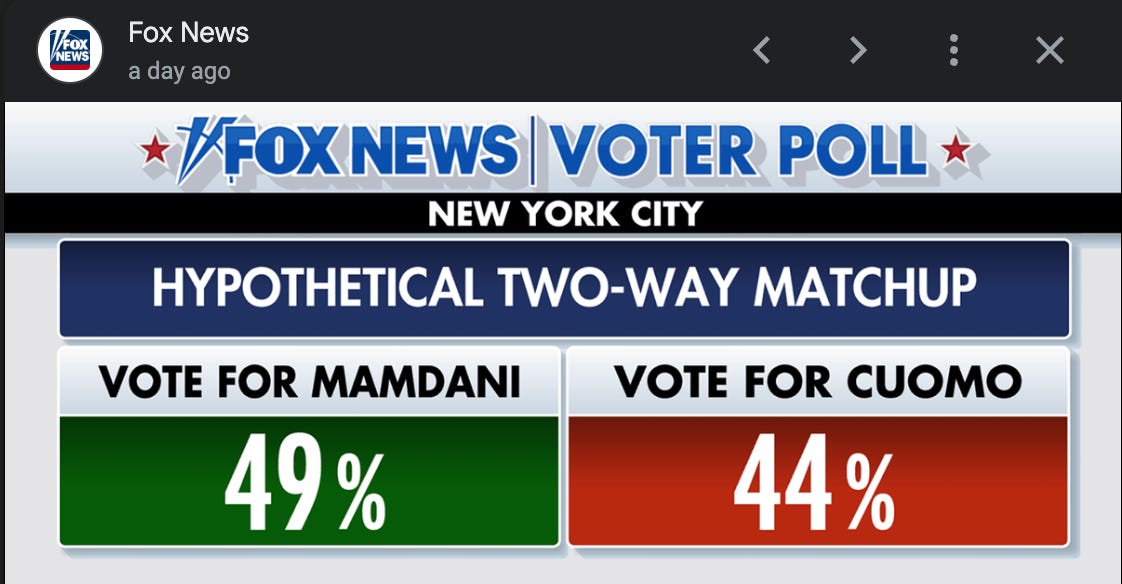
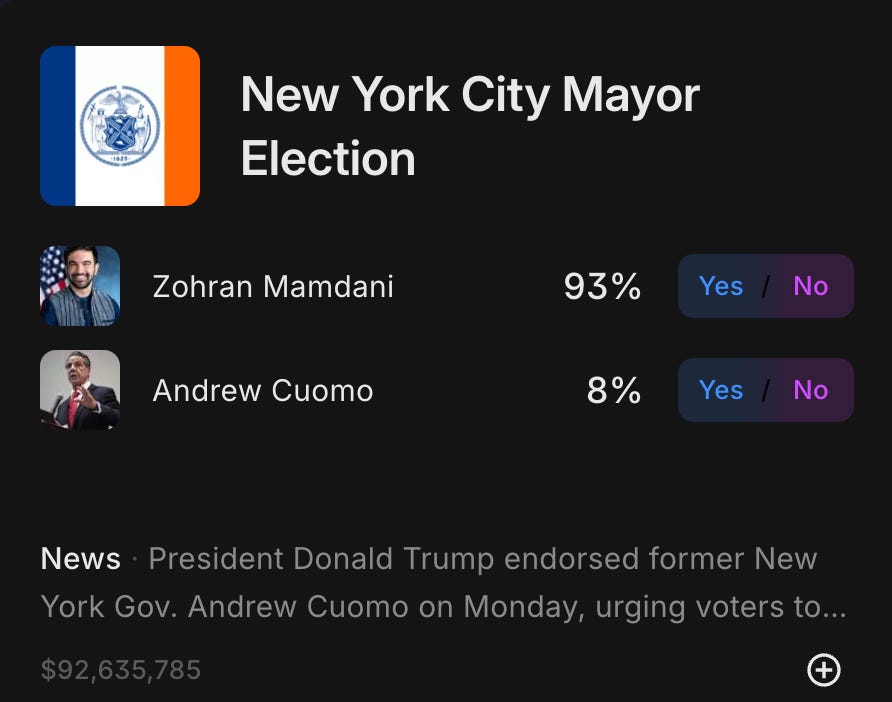
Look at that
Prediction markets turn beliefs into prices. A market price aggregates participants’ real money bets and, in real time, absorbs every new piece of information. If someone buys a contract that Zohran will win a race or pass policy X, they’re putting capital behind that belief.
Predictions are not infallible, but markets are good at surfacing probabilities as people weigh incentives.
Polls capture what people say they feel.
Markets capture how people spend their money.
If pundits treat a flurry of headlines as determinative, markets often push back by revealing the degree of conviction behind the headlines. A big media story can inflate impressions, however a market price forces quantification.
How many people truly think the story matters enough to put money on it?
Mr. Mamdani is young, bright, and active on the issues; he’s going to make errors, adjust, and learn. Isn’t this the arc of any promising politician? Modern media loves instant obituaries; prediction markets help us frame the discussion proportional to the underlying evidence.
A concrete example: taxi policy and the city’s drivers
One reason Mamdani deserves real credit is the hands-on work he’s done for cab drivers and other frontline workers. Uber’s rise reshaped the city’s taxi and limo landscape, collapsing medallion values once treated as durable personal assets. Medallions were once worth over $1M each; cab drivers indebted themselves to the gills in an effort to procure them so they could legally drive a yellow cab. Once Uber helped crash the medallion values - drivers were in half a Billion in debt over something comparatively worthless. As a NY State Assemblyman (like state Congress), Zohran led the successful effort for debt-relief.
Markets don’t eliminate bias; they monetize it
Markets help us temper the “destined or doomed” framing. If you’re curious about how to think about the future without being hostage to headlines, consider putting polls and markets side by side. Where polls tell you what a population is saying now, a prediction market tells you what a crowd is willing to put money on. Neither replaces judgment, but both sharpen it.
By the way prediction markets are not the same as gambling, although they share some of the same degens as customers. Unlike gambling, which involves a bookmaker and a built-in “vig” or house edge, prediction markets typically only charge a small transaction fee and do not set odds. In this regard it is much more similar to how you might use Fidelity to trade stocks.